

Outbound SMS Logs#
Outbound SMS logs list a record for each SMS that you sent through your SMS trunks. Use them to monitor outbound messages, check charges, and troubleshoot failed messages.
To open the logs, in the DIDWW User Panel, go to Logs & Analytics > SMS Logs > Outbound.
Outbound SMS log filters#
Date / time (UTC), Source address, Destination address, and Status are always shown. To show or hide SMS trunk, SMS ID, Service type, and Sender ID Verification, select them in the Filters menu. Reset all inputs in the same menu clears all filter values.
Filter |
Description |
|---|---|
Date / time (UTC) |
Shows SMS sent in the selected period: |
Source address |
Shows SMS sent from the entered source addresses. Select |
Destination address |
Shows SMS sent to the entered numbers. Select |
Status |
Shows SMS with the selected status: |
SMS trunk |
Shows SMS sent through the selected SMS trunks. |
SMS ID |
Shows the SMS with the entered SMS ID. |
Service type |
Shows |
Sender ID Verification |
Shows SMS sent with the selected Sender ID verifications. |
To filter by several values in one field, separate them with commas (,)
or spaces. For example, enter 123,456 or 123 456.
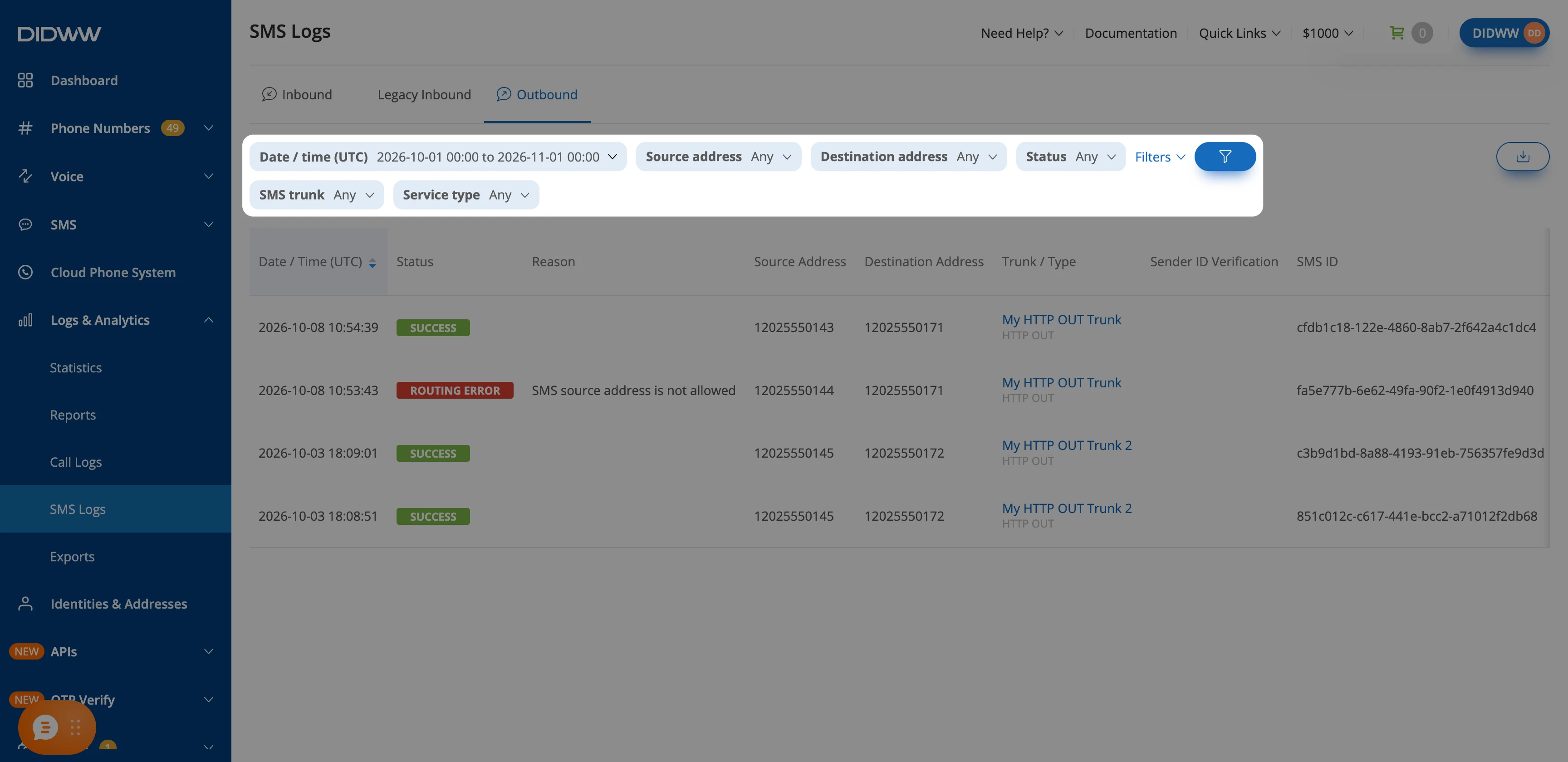
Fig. 1. Outbound SMS log filters.#
Outbound SMS log fields#
Each record is one outbound SMS. A long SMS sent in several fragments is one record.
Field |
Description |
|---|---|
Date / Time (UTC) |
When DIDWW received the SMS from your SMS trunk. |
Status |
How DIDWW processed the SMS, for example |
Reason |
Why the SMS was not sent, for example |
Source Address |
The sender of the SMS: a phone number or a Sender ID. |
Destination Address |
The number the SMS was sent to. |
Trunk / Type |
The SMS trunk the SMS was sent through, and its type, for example
|
Sender ID Verification |
The Sender ID verification used for an A2P SMS. Empty for a P2P SMS. |
SMS ID |
The identifier DIDWW assigned to the SMS. |
Billed Fragments |
The number of billed fragments. |
Charged (USD) |
The total charge for the billed fragments, in USD. |
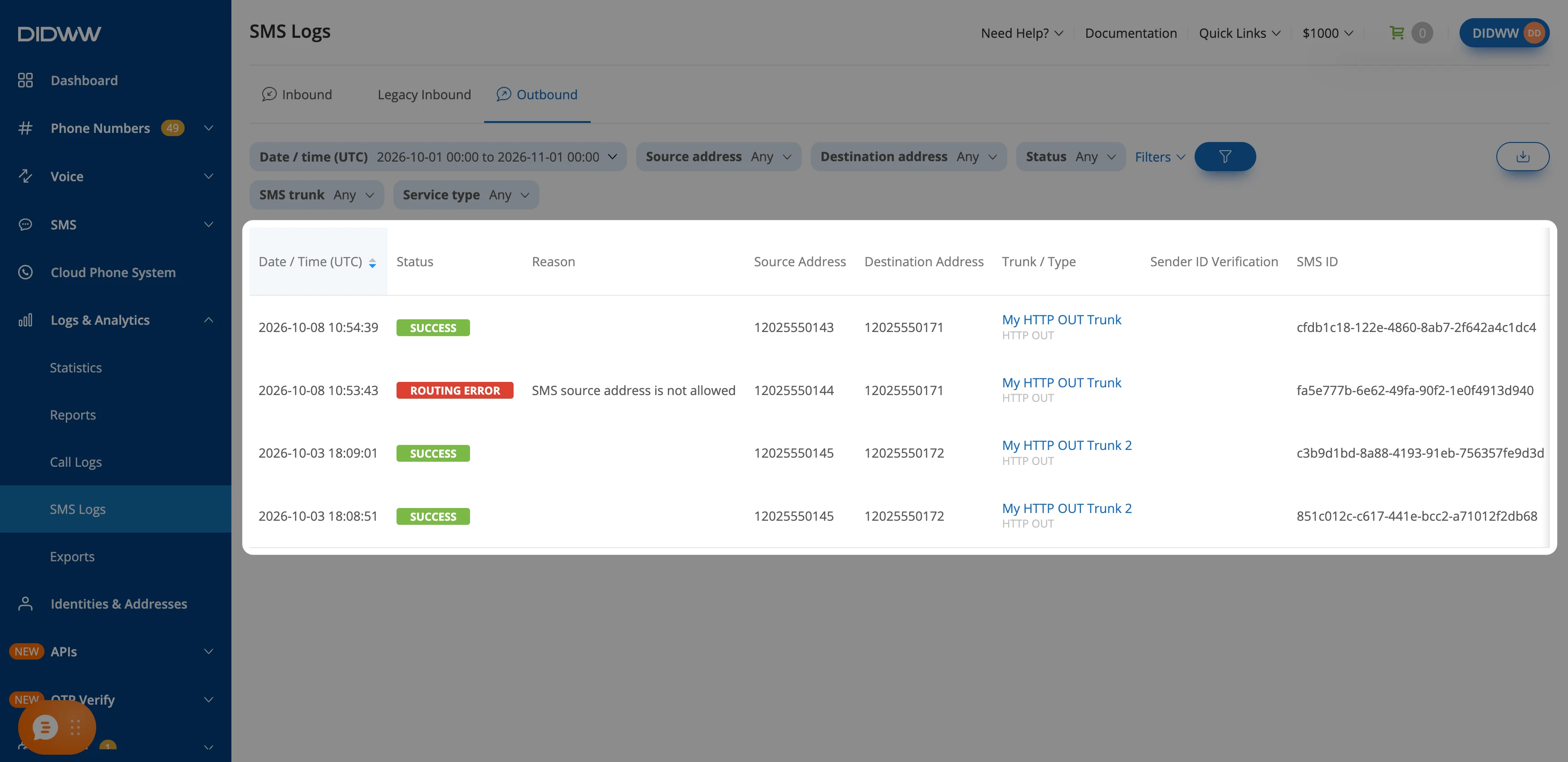
Fig. 2. Outbound SMS logs.#
Outbound SMS statuses#
The Status shows how DIDWW processed the SMS. For SMS sent through an
HTTP OUT trunk, SUCCESS, ROUTING ERROR, and FAILED match the
status of the message status callback. Queued and In Progress are
intermediate states that are not reported in the callback.
Status |
Description |
|---|---|
|
DIDWW sent the SMS to the carrier. This does not confirm that the recipient received it. |
|
DIDWW could not route the SMS, for example because the trunk cannot use the sender. The SMS is not sent and not charged. See the Reason. |
|
The SMS failed. See the Reason. |
|
Filter value for SMS that DIDWW accepted and has not sent yet. |
|
Filter value for SMS that DIDWW is sending. |
The logs do not show the final delivery status. To know whether the recipient received an SMS, use its delivery receipt (DLR):
HTTP OUT trunks: The DLR event of the status callback. See Processing status and delivery status.
SMPP trunks: The DLR that DIDWW sends in a
deliver_smPDU. See SMPP message flow.
How outbound SMS are billed#
Outbound SMS are billed per fragment, not per message. A long SMS is sent in several fragments, and each fragment is billed at the rate for the destination and the service type (A2P or P2P). The Billed Fragments field shows how many fragments were billed, and Charged (USD) shows the total charge.
You are charged only for the fragments that DIDWW sent to the carrier. If
no fragment was sent, the SMS is not charged, and Billed Fragments and
Charged (USD) show -.
Status |
Billing |
|---|---|
|
Billed for each fragment sent. |
|
Not billed. DIDWW could not route the SMS, so no fragment was sent. |
|
Billed only for the fragments that were sent before the SMS failed. Not billed when no fragment was sent, for example when no balance was available during the SMS’s time to live. |
|
Not billed yet. The charge is shown when DIDWW finishes processing the SMS. |
How fragments are counted#
The number of fragments depends on the length of the SMS and its encoding.
For SMS sent through an HTTP OUT trunk, DIDWW uses GSM-7 when every
character of the message is in the GSM-7 alphabet. Otherwise, the whole
message uses UCS-2. Over SMPP, the data_coding parameter of each message
sets the encoding. A header is added to each fragment of a long SMS, so each
fragment holds fewer characters than a single SMS.
Encoding |
Single SMS |
Each fragment of a long SMS |
|---|---|---|
GSM-7 |
160 characters |
153 characters |
UCS-2 (Unicode) |
70 characters |
67 characters |
The limits count GSM-7 basic-alphabet characters. GSM-7 extension
characters, such as €, [, and ], use two positions each.
For example:
An SMS of 160 GSM-7 basic-alphabet characters is billed as 1 fragment.
An SMS of 200 GSM-7 basic-alphabet characters is billed as 2 fragments (153 + 47).
An SMS of 100 Cyrillic characters uses UCS-2 and is billed as 2 fragments (67 + 33).
On an HTTP OUT trunk, one emoji switches the whole SMS to UCS-2, so a short English message with an emoji can need more fragments than the same message without it.
For more examples and the encoding rules, see SMS encoding reference. For current rates, see DIDWW pricing.