

PSTN Trunk#
PSTN trunks allow you to forward incoming calls through Direct Inward Dialing (DID) to the Public Switched Telephone Network (PSTN).
Note
Incoming calls forwarded to a PSTN trunk are charged per minute. The rate and availability depend on the destination PSTN phone number.
Create a New PSTN Trunk#
To create an inbound PSTN trunk, follow these steps:
Navigate to the Voice section in the left-hand menu.
Select Inbound Trunks from the submenu.
Click the Create New button in the top-right corner of the screen.
From the dropdown menu, select PSTN Trunk.
Fig. 1. Creating a new PSTN Trunk#
Quick PSTN Trunk Configuration Guide#
To quickly configure a PSTN trunk, enter the required information below:
Enter a Name - Provide a unique name to identify the trunk.
Enter the PSTN Phone Number - Specify the destination number in E.164 format (e.g.,
12065550100).Click Check Rate and review the displayed per-minute rate.
Click the Create button to save and activate the configuration.
Note
The rate and destination availability depend on the PSTN phone number. To review current pricing, see DIDWW pricelists.
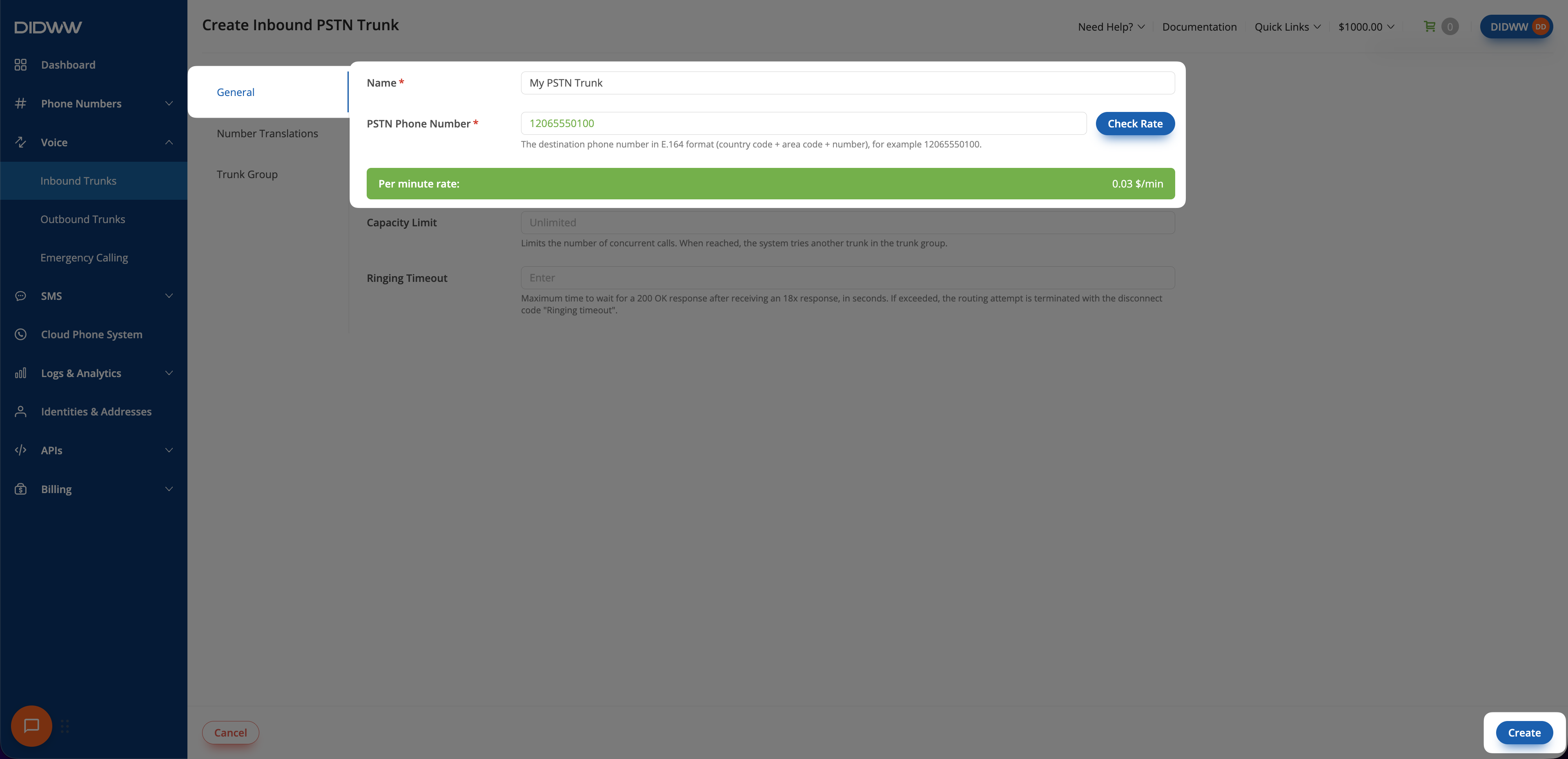
Fig. 2. Quick PSTN trunk configuration#
Advanced PSTN Trunk Configuration Guide#
For advanced configurations, you can customize additional PSTN trunk settings.
Configure the destination, capacity, and ringing timeout.
Configure caller ID filtering using a number list.
Assign trunks to groups for failover and load balancing.
General#
The General tab defines the PSTN destination and call limits for the trunk.
You can configure the following settings:
Name - Enter a unique name to identify the trunk.
PSTN Phone Number - Enter the destination number in E.164 format to which calls are forwarded (e.g.,
12065550100).
Note
Click Check Rate to check whether the destination is available and display its per-minute rate.
Capacity Limit - Specify the maximum number of simultaneous calls allowed for the trunk. Leave the field set to Unlimited to apply no trunk-specific limit. When the limit is reached, the system attempts to route the call through another trunk in the trunk group.
Ringing Timeout - Specify the maximum number of seconds to wait for a
200 OKresponse after receiving an18xresponse. When the timeout is reached, the routing attempt ends with the Ringing timeout disconnect code.
Fig. 3. General tab#
Number Translations#
The Number Translations tab configures caller ID filtering for the PSTN trunk.
CLI Number List - Assign a Number List to allow or reject incoming calls based on full number matches, prefix matches, or length restrictions. For more information, see the Number List documentation page.
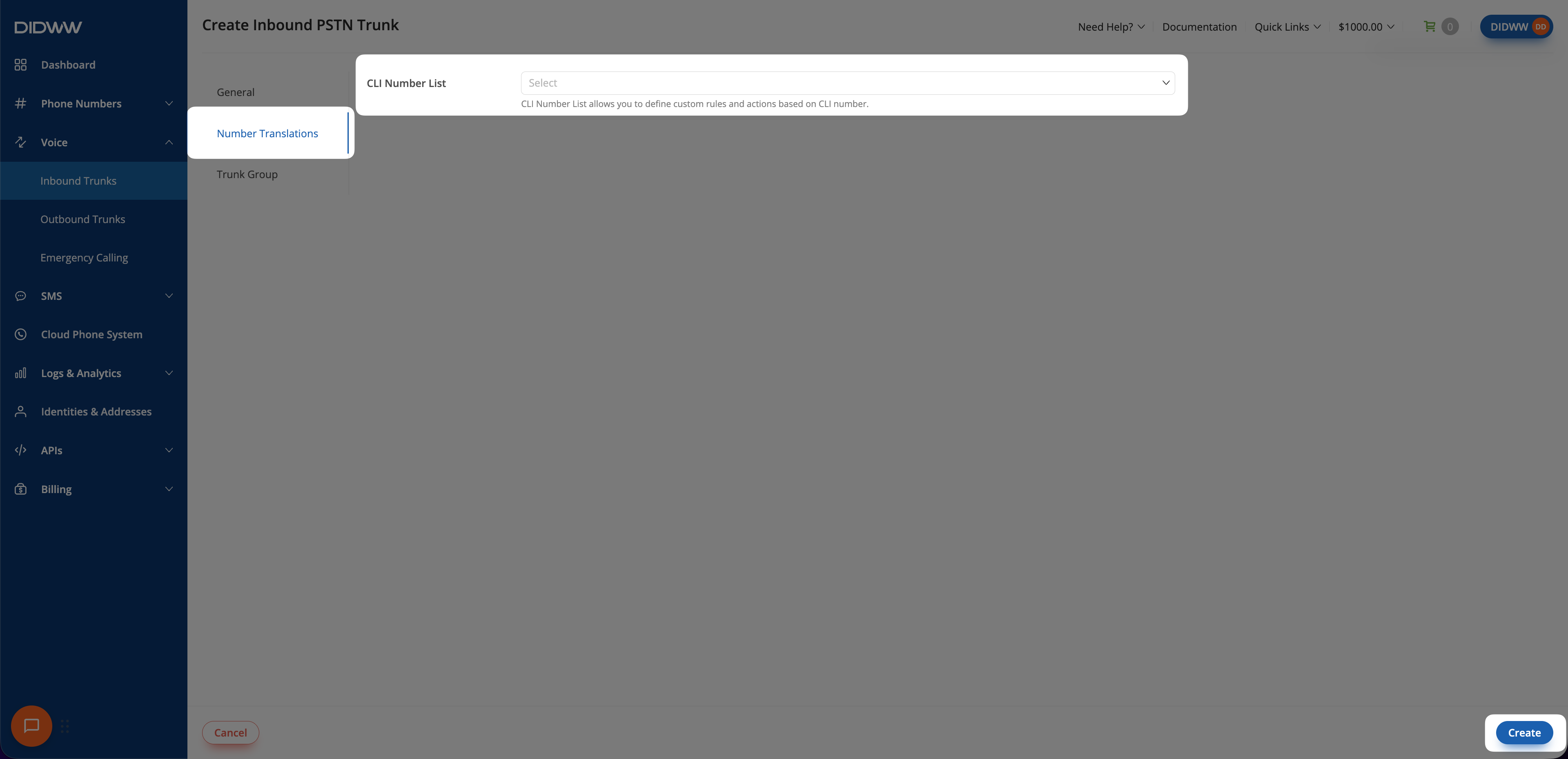
Fig. 4. Number Translations tab#
Trunk Group#
PSTN Trunk group configuration is optional and should only be used when multiple trunks need to be assigned to a single trunk group for failover or load balancing.
You can configure the following settings:
Trunk Group - Select the trunk group to assign the trunk to. A trunk can belong to only one trunk group. If no trunk groups exist, see the Trunk Group Creation Guide.
Priority - Set the trunk priority within the trunk group. Trunks with lower values are tried first. Trunks with the same priority are ordered by weight. For more details, see RFC 2782.
Weight - Set the relative weight for trunks with the same priority. A higher value increases the likelihood that the trunk is selected. For more details, see RFC 2782.
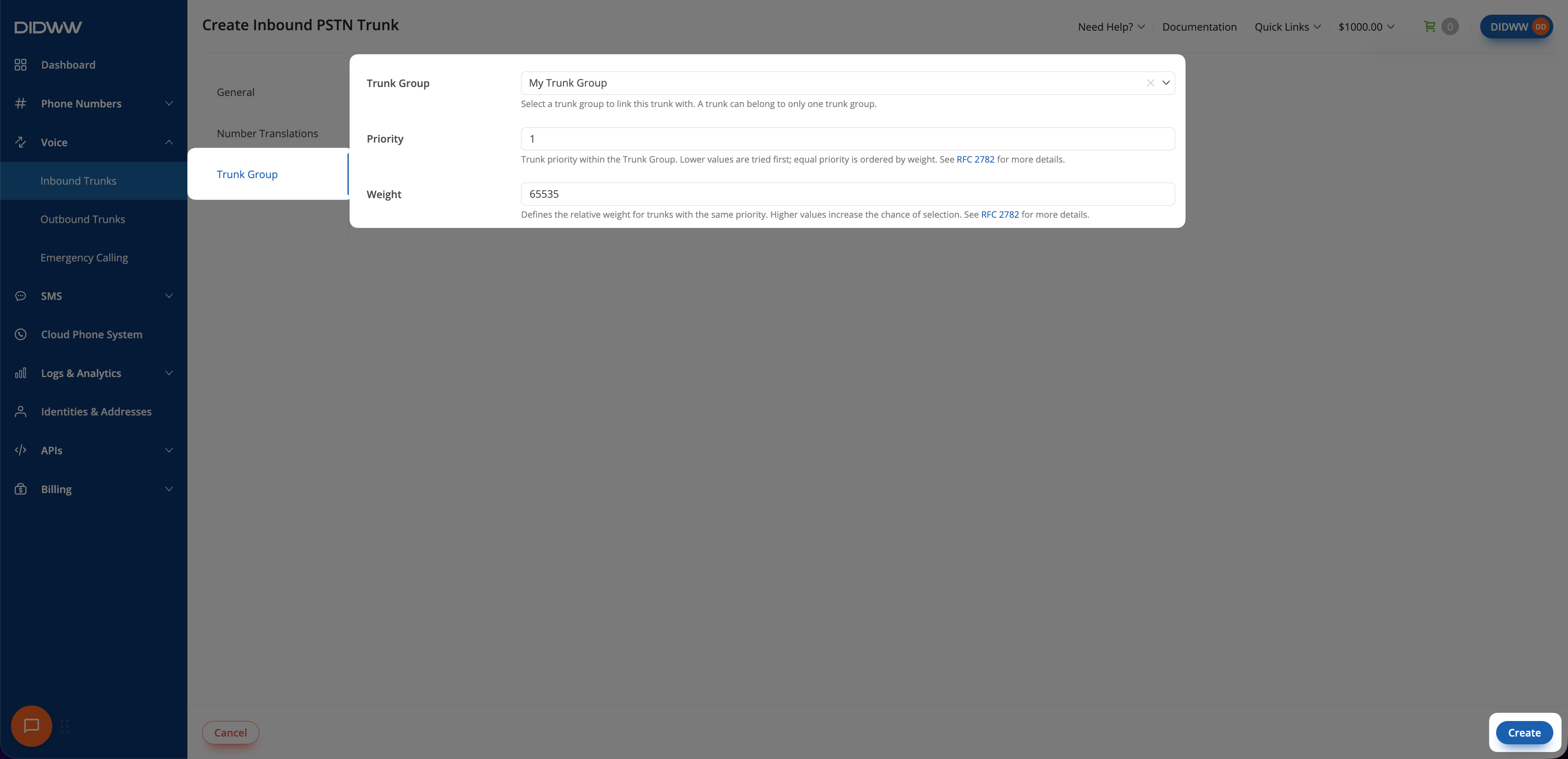
Fig. 5. Trunk Group tab#
Edit PSTN Trunk#
To edit an existing PSTN Trunk, follow these steps:
Navigate to the Voice section in the left-hand menu.
Select Inbound Trunks from the submenu.
Locate the PSTN trunk that you want to edit and click the
 button.
Click Edit.
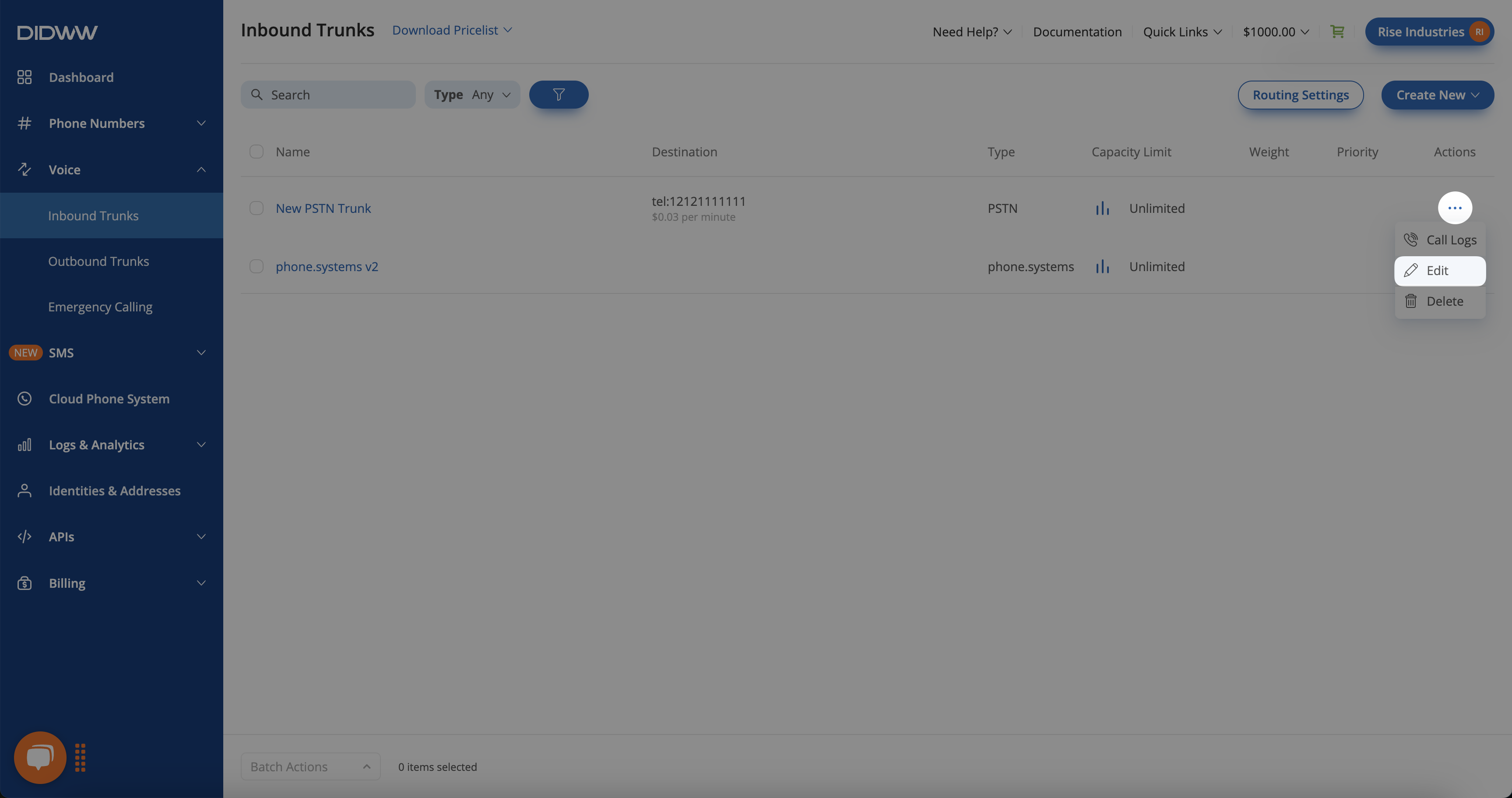
Fig. 6. Actions Button.#
In Edit Inbound PSTN Trunk, make the required changes and click Submit to save them.
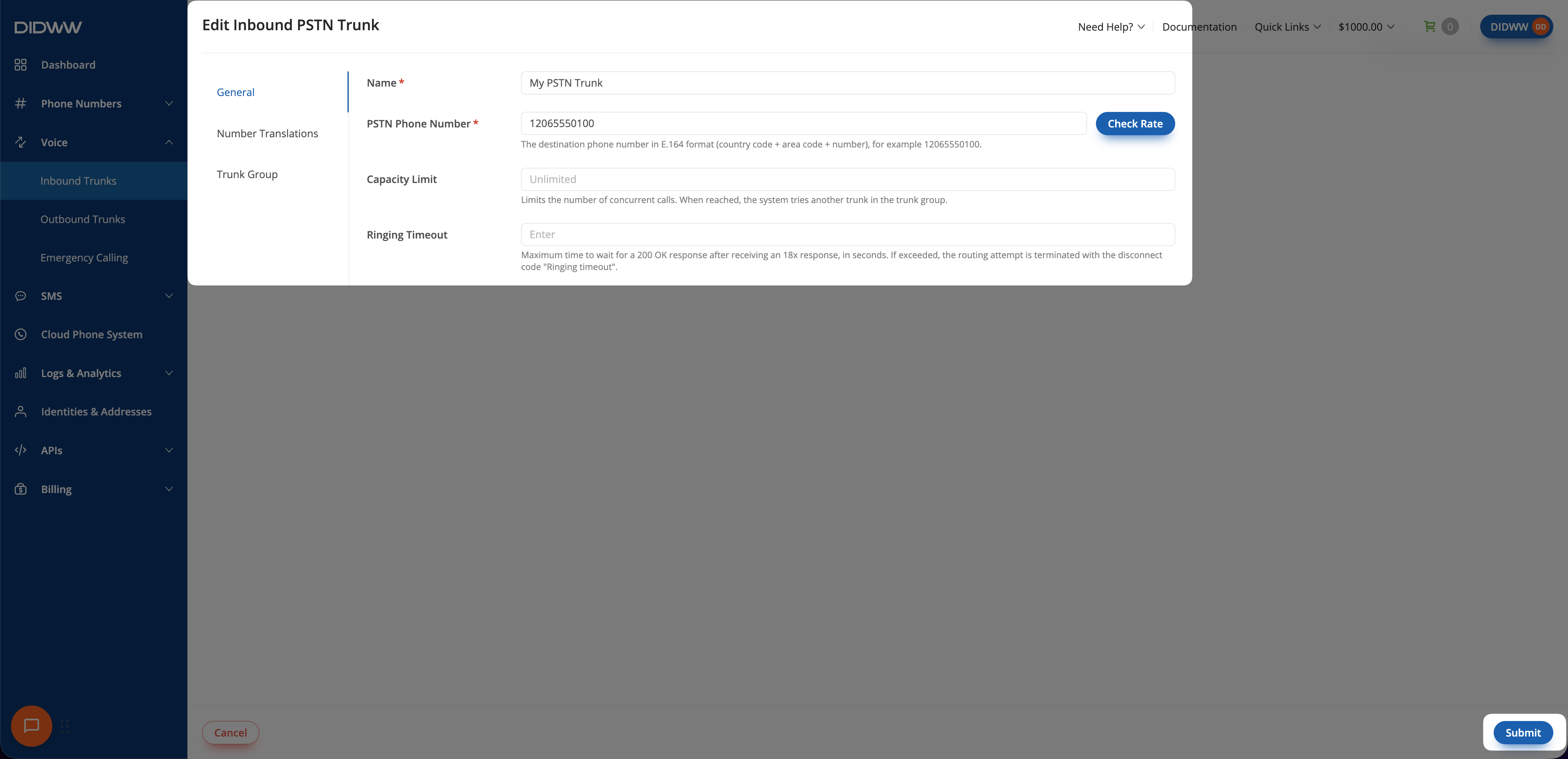
Fig. 7. Edit Inbound PSTN Trunk.#
Delete PSTN Trunk(s)#
You can either delete a single PSTN trunk or delete multiple PSTN trunks by using batch actions.
Note
Trunks assigned to DID numbers or in use cannot be deleted.
Delete a Single PSTN Trunk#
To delete an existing PSTN Trunk, follow these steps:
Navigate to the Voice section in the left-hand menu.
Select Inbound Trunks from the submenu.
Locate the PSTN trunk that you want to delete and click the
button.Click Delete.
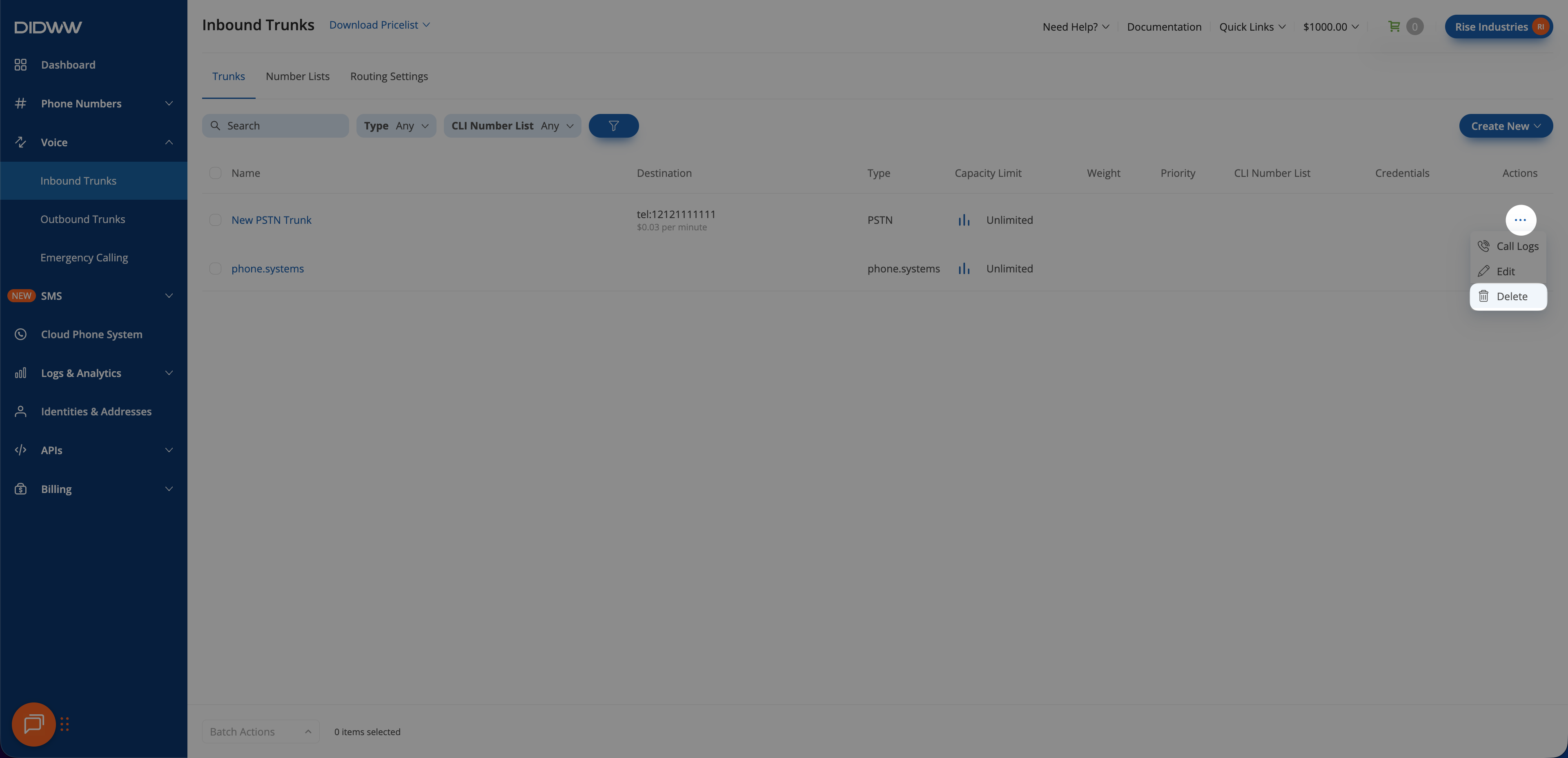
Fig. 8. Actions Button.#
In the Delete Trunk(s) pop-up window, click Delete to confirm the trunk deletion.
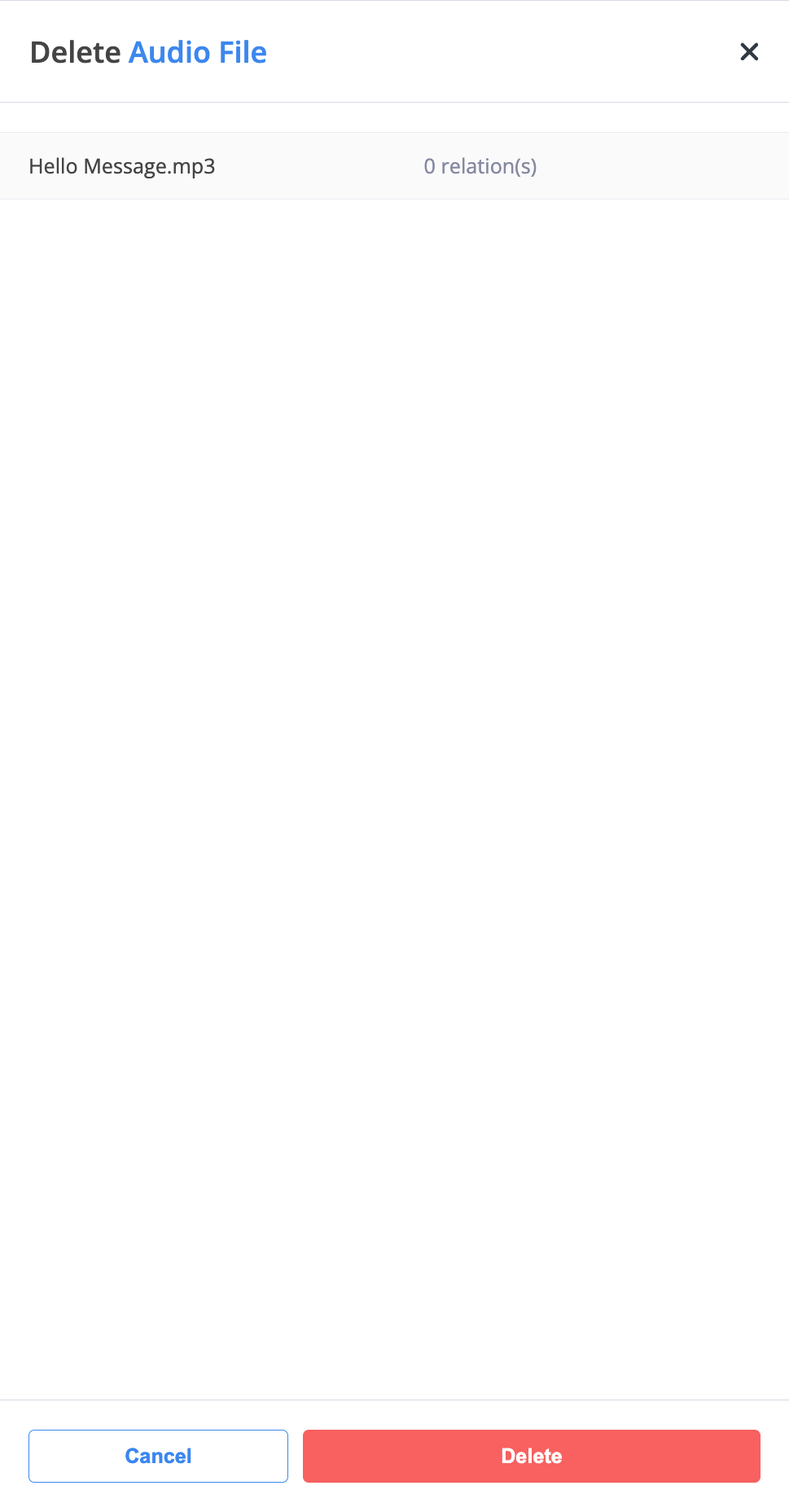
Fig. 9. Delete Trunk(s) confirmation window.#
Delete Multiple PSTN Trunks#
To delete multiple existing PSTN Trunks, follow these steps:
Navigate to the Voice section in the left-hand menu.
Select Inbound Trunks from the submenu.
Select the PSTN trunks you want to delete.
Click Batch Actions and then select Delete Trunk(s).
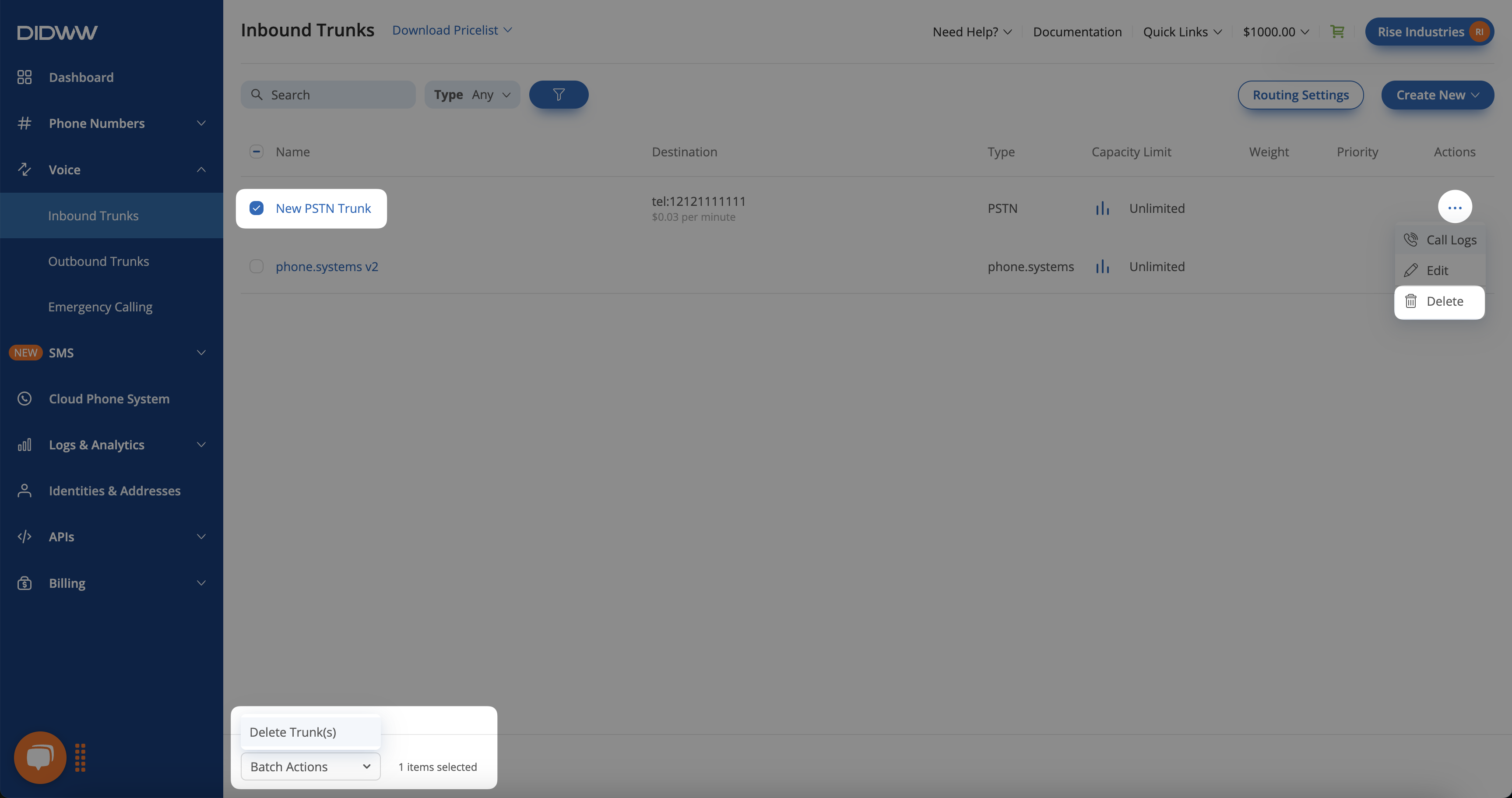
Fig. 10. Batch Actions Button.#
In the Delete Trunk(s) pop-up window, click Delete to confirm the trunk deletion.
Fig. 11. Delete Trunk(s) confirmation window.#
Additional Information#
Learn how to configure DID numbers with trunks and trunk groups for routing inbound calls.
Create and configure SIP trunks for inbound calls, set transport protocols, authentication, media options, and more.